Monday, May 8, 2017

The dry season begins

May 2017

The dry season has arrived in central Brazil and the good news is that in our area the rainfall for the rainy season (October 2016-April 2017) surpassed each of the last three years according to Guy’s approximate measurements: 
2013/14 - ? millimeters (I'll fill this in as soon as I can.)
2014/15 – 1272 ml 
2015/16 – 1057 ml 
2016/17 – 1500 ml 
However we’re learning that the depletion of the water table in this area has been going on for many years -decades - and that one good year won’t have much of an impact as more land is cleared and more water used to supply growing populations and to irrigate increasing monocultures of soy, corn, sugarcane and other crops.

The pump is dangling by black hose in the deepest water hole, just down from our house.
We’ve installed a pump (electric) to draw water from the creek that flows by our property. The water isn’t as clean as the water that comes half a mile from the spring above my son’s house whose water system we tap into. But our own water supply will work for irrigation and for emergencies if the other system gets low. We’re also planning to build a cistern to collect rain water, and a pond that will hold water in all but the driest years.

What way will this region go as climate change progresses? Wetter, drier, mixed? Experts are telling us that if forests are protected and replanted it will rain more, but agro-business, promoted by the government, is taking us in the opposite direction. And the small effort I agreed to initiate with a local friend, an organization that would protect the local waterheads, is proving difficult to get off the ground. People are too busy, their personal lives too compelling – justifiably or not – to attend meetings, organize events, actually plan the reconstruction of a spring that’s been degraded. (Sound familiar?) I haven’t given up so stay tuned.

Our young male goat, next to his dam.
As for our personal projects here on the farm, the big news is that we butchered our first young goat, a six-month-old wether. We raised this cabrito with kindness, in a nice pen large enough for him to run and play with other goats. We had him castrated by a neighbor who is our stand-in for veterinarian counsel and action due to his long experience with animals, especially the sheep that he cares for for his boss.

Roast leg of goat - very tasty.
Now a roast, two legs and two racks of ribs fill our small freezer, after we roasted the first hind leg when my daughter and her partner came to visit from the US. I had to learn how to marinate it so that it would be tender and flavorful, and it was a wonderful success. And we gave one of the front legs to our friends in town. We find that most people around here are loathe to try food they’re not used to, like goat milk and meat, but a few people are curious or have traveled and welcome the opportunity to experiment.

We raise goats partly to explore the advantages they represent over the prevailing and growing beef consumption. Around the world people have learned to equate prosperity with having abundant meat on their table. Cattle raising means hundreds of acres of land cleared for pasture, both here in the cerrado (our richly bio-diverse savannah) and in the Amazon.

Permaculture teaches us to think small and efficient, focusing on the resources of the land under our feet and the vegetation that surrounds us. Goats can be raised on small farms and even in large backyards, providing milk and meat in exchange for corn, hay and the prunings of bushes and trees.

We don’t try to keep a male goat to impregnate our does. Instead we transport our pretty ladies to a neighboring farm where a herd of goats roam a fairly large area of grass and woods. Male goats are difficult in close quarters due to their ornerish personalities and a distinctive and very unpleasant odor. Our place is too small.  

This variety of banana is called 'nanica,' which means 'small.'

The two bunches on these trees are 'banana prata.' We also have 'banana maçã' and 'banana marmelo.'

The banana plants we put in two years ago (May 2015) are finally producing bananas, which look like they’ll all ripen – it takes months – at approximately the same time, hopefully when my son and grandsons visit in July. 

Our eight hens are laying four or five eggs a day, fewer than a month ago due to the shorter days – supposedly hens require fourteen hours of daylight to produce an egg. Right now the sun rises at about 6 am and sets at 6 pm. The mama hen doesn’t lay eggs while she cares for her brood, but eventually she’ll start up again and her little pullets should start laying in September.

Mama hen and chicks enjoy a dust bath.
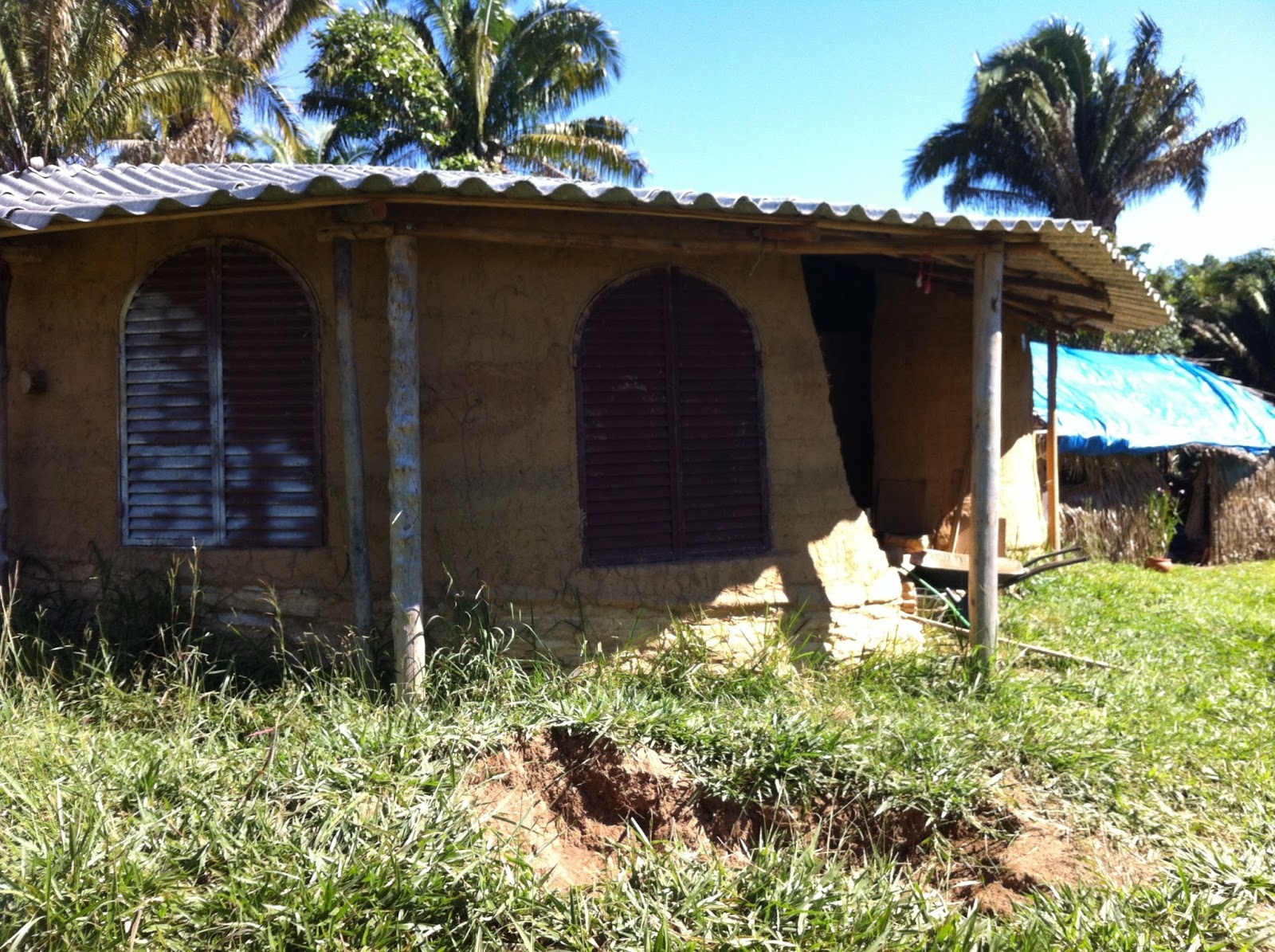
And here's a look at the latest stage of the cob house, outside and in. Notice that the walls are finished all the way up to the roof. Next steps include new layers on the floors, ceilings in the bedrooms, and some cob furniture - seats along the walls, an alcove, and a bookcase.


I look forward to hearing from you. Leave a comment if you please.

Wednesday, February 22, 2017

The big cob-house update

The last time we showed you our cob house the roof frame was beginning to go up, back in October. I'm taking a step back to show the whole process of getting the roof up. By the end of this post the house will have developed dramatically. I hope you enjoy these photos.

October 17, 2016 - The house unprotected. For a year we had a tarp over the house to protect it from the rain. Guests slept in the rustic rooms with good windows and doors but only a large blue tarp to cover it.
Oct. 19 - The roof structure goes up.

The recycled tiles are made from used milk boxes - heating and molding the aluminum and plastic remains
into strong but  lightweight and pliable tiles.
We hired a local builder and his brother to put up the roof.
The weather cooperated, cloudy but without rain.
Nov 10 - The finished roof, nicely rounded with a small circular saw.
Another view of the completed roof.
The space between the wall and roof must now be filled in. Eventually the roof
will be supported by the wall and some of the posts will be removed.

Handing up the cobs to be added to the top of the wall.
Cob meets roof.

We created vent holes with screening. 
Dec 28 -The walls of the two bedrooms and the bathroom are almost completed.

Jan 17, 2017 - Now it's time to work on the two level floor:
living room above, entry-level kitchenette below.

Guy empties one of the unending wheelbarrows of gravel. At the back sits a
handmade water level. 

Lolita and Cindy inspect the premises while Guy starts filling the lower level.
The tamper is used to make the floor as solid as possible.

Stones, gravel and sand are delivered just outside our property since the
bridge isn't strong enough for heavy trucks.

It's a pretty stretch but long after about twenty cartfuls. 
Especially since its' uphill.

Feb 1 - The next floor layer is made of earth, sand, gravel and straw.
It's pocked so that the next layer will adhere. 

We decided to make a ramp between levels since we have a wheelchair-bound
friend. And, who knows, we might need it ourselves in the future.

Feb 7 - Now we're placing the used windows we bought back in October. 
The three large windows have to be propped and tied in place until
the walls go up around them.


We get an idea of what the windows will look like from the outside. The space looks smaller from this perspective.


Today, a week later (February 22) I took the final photos for this update. 


The cob has gone up almost two feet, holding the windows firmly in place. 


Since we've decided to wait a few weeks before building the front wall with its doorways and window, the cob wall has been tapered so that the next piece of wall supporting the main doorway will join more securely.


                     The space looks inviting in the morning sun. The tall window at right will open into an alcove.
(I just realized I should have a photo taken from the same angle as the first photo in this post. I'll take that picture and get it posted as soon as I can.) Feb 23: Here it is:

The cob house as of February 23, 2017


Tuesday, February 7, 2017

Once again we want to put out an appeal to anyone who is ready for a Brazilian  adventure and eager to learn about cob or to participate in a permaculture project – come join us for a week or two. To come from the US you will need a minimum of around $2000  for airfare and incidentals. We will pick you up at the airport in Brasilia and host you (good food and wonderful sleeping in a quiet dark space where the stream gurgles by and the stars jump out at you at night) in exchange for four or five hours of work a day, very flexible. Of course, there is a whole lot more to see and explore in Brazil and Latin America. Contact us through the Comment section below, or by email or Facebook.


Mangoes and guavas on window sill.


January             2017

In these times of political unrest, both in Brazil and the United States, I sometimes wonder if we’re in the right place, doing the right things. Guy often wishes he were in the US in order to participate in marches and other actions to protest the direction this new president is taking the country, and to hold our elected officials accountable for preserving the rights of every American as well as safeguarding the rights of those world citizens, including countless children, who have been displaced as a result of the war-making in which the US is complicit.

On the other hand, our work here compels us to continue with ongoing projects. The cob house is more than halfway done, goats and chickens need daily attention, fruit trees require care. We’ve also taken our commitment to ‘living into our place’ to another level as we help found and build a non-profit organization which will dedicate itself to the preservation and recovery of springs and creek beds in this high plateau where many rivers have their source.

Looking North toward the crest of the Continental Divide of Central Brasil and to the beginning of the Amazon Basin beyond. We live just South of the divide at the beginning of the La Plata Basin. 

Just two miles north of us runs one of the ridges of the continental divide - between the Amazon River Basin to the north and the Plata Basin to the south. Rainfall here has decreased steadily over the past few years (climate change?) while farmers, large and small scale, continue to clear land with reckless disregard for ecological balance. People in this area of abundant water are for the first time in memory worrying about the  water running out. In Brasilia, only 60 miles away, water rationing  has become necessary. If it doesn’t rain enough between now and May, when the dry season starts, the situation could be drastic, even deadly. So it makes sense for us to stay here and do our bit for sustainability.

The site of a spring that has been totally cleared of trees to make a watering hole for cattle. 

Our permaculture project began its sixth year in August and we moved into the first house we built a full four years ago. Trees that we planted back then have begun to bear fruit: pomegranate, pitanga, coffee and orange. Guy has produced two years of fully-cured humanure that we use in our vegetable garden and on our fruit trees. I’ve developed a flock of chickens with Rhode Island Red hens that are just beginning to lay, and we collect four eggs a day already. Our goats provide enough milk for our daily needs and we’re learning to make cheese.

Among other things, I would like to plant ginger and turmeric – both grow well around here -  to use with goat milk to make turmeric tea, supposedly a powerful anti-inflammatory.

Very soon I plan to post a complete update on the cob house so I won’t go into any details in this entry. Please stay tuned.

A peek at the cob house with its new roof.


Sunday, January 29, 2017

Almost there!

I wrote this post in late October however earlier attempts to publish it failed - and it sat languishing for three months. Much has happened since then and very soon I'll publish two entries in order to catch up.


Almost there!

Our neighbor, Marli, has been building the walls of our cob house since I had to stop, and now two of her brothers have worked since Monday this week to put the roof over the whole house. The two bedrooms are finished, except for the final foor layers and wall plaster and Marli just completed the foundation for the living/dining area, but we’re taking a break from the cob building until we get the doors, windows and other parts together. (With the two bedrooms we got the walls most of the way up and then had to partially cut out holes for the doors and windows – a waste of energy and time.) It will be great to have the whole space covered and protected from the rain. 

Cob house with blue tarp that was up for over a year.

Cob house without any cover.

Current work on the cob house - wood structure for the tile roof.

Animal management takes a lot of our time. We get up early to feed the goats and milk Polly whose two kids spend the night enclosed in a pen away from their mother. We’re getting three cups of milk every day now. We made a difficult decision: we got rid of Nina and Daisy, and are keeping the two Nubians, Polly and Nellie. “Developed in England, the Nubian is popular among makers of cheese and ice cream because its milk is so rich. This goat comes in many colors, most typically bay or black, and is the most energetic, active, and talkative of the dairy breeds.” (Damerow, Gail, The Backyard Homestead Guide to Raising Farm Animals.) Nellie has returned from the farm where the went last month to hang out with the billy goats, and hopefully the fullness in her body means she's pregnant, expecting in February. 

The chickens require little care other than feeding them in the morning, making sure they have plenty of fresh water, releasing them late morning, gathering eggs, and enclosing them at dusk. As I described in the last post, from time to time we have to deal with a broody hen - right now we have one isolated in the cooling down pen and are only collecting two eggs a day. 


Lolita in the pit.
Then we have our pets, Lolita and the cats. Lolita tore her leg on a piece of wire and the sore was invaded by flies that lay their eggs inside. It was taking forever to heal so I took her to vet. Now she has a collar to keep her from licking her wound, and she reminds me of the RCA dog. 


Our little orphan kittens seem to be doing fine. When they're not sleeping they're all over the place, very cute.
The cats usually require almost no care but suddenly Fofa, who birthed kittens in the beginning of September, has gone missing and we have two of the cutest little devils to take care of. They’re drinking goat milk out of a bowl and eating both cat food and dog food. I miss Fofa. The other adult cat is Cindy, a pretty Calico, and she’s no trouble at all. I assume that she catches any mice who make the mistake of coming around for corn and other foodstuff. Lolita also has a job and that’s to bark when any stranger, including the monkeys, comes onto the property. She’s good at her chore, sometimes she overdoes it, but fortunately she doesn’t bite.


Lolita and Cindy.

When we moved onto this piece of land several fruit trees remained from the prior dwellers who’d lived here about fifteen years before. There were five mango trees, two China limes, a dying orange, several guavas, and five jabuticaba trees, the latter being a superb fruit endemic to Brazil that is now cultivated in many places including Florida. We’ve pruned the old trees and all of them, including the orange, are doing well. 
More limes than we can use - lemonade, salad dressing, caipirinhas, lemon bars - yumm.

Jaboticabas- a few green fruits growing on the trunk while a new set of blossoms are beginning to flower.

We’ve also planted numerous fruit trees, coffee, and a small banana grove. We picked our first coffee beans last season, and pitangas (a delicious cherry-like fruit) this year. One of the new orange trees is flowering right now as well as a pomegranate. The passion fruit vine is flowering profusely but no sign of fruit.